In my presentation, I have drawn primarily on the work of Lee & Spratley, Smagorinsky, the Common Core State Standards, and Lattimer.
Monday, May 15, 2017
Disciplinary Literacy in ELA
Here is the final component of my blog and disciplinary literacy study by focusing on how this applies to ELA. This covers the types of texts that are read and created in ELA, the questions effective readers ask, the terminology and concepts that need to be properly understood to ask these questions, and examples of engagement strategies to introduce these skills.
In my presentation, I have drawn primarily on the work of Lee & Spratley, Smagorinsky, the Common Core State Standards, and Lattimer.
In my presentation, I have drawn primarily on the work of Lee & Spratley, Smagorinsky, the Common Core State Standards, and Lattimer.

Friday, May 5, 2017
Mapping the Text
For my visualization project, I put together a map which brings together cites from Maus, The Diary of Anne Frank, and a few contextualization sites.
I found myself indecisive as I
worked on selecting my visualization method.
Initially, I favored a timeline approach because this seemed the most
straightforward. My idea was to have
students place events of whichever text they worked with on a timeline with
events from the war. However, I didn’t
really like any of the recommended timeline platforms and I couldn’t find one
on my own. This led me to using an
interactive map. Initially I was leaning
towards MyHistro and worked with it for a short time. I changed my mind yet again when I realized
that Google Maps had an option for creating your own interactive map and I
found it to be user friendly and fit my needs exactly. Like my original idea for the timeline, I
wanted to be able to juxtapose the events of the texts with the wider events of
the war. However, using locations and
the map to do so proved to be more effective.
In the end, I found when I put the
map together that this worked better than I originally thought it would. Maus
in particular has a wide geographic reach.
I was not fully aware of the location of many of the towns mentioned,
aside from the fact that they were in Poland.
Placing these locations on a map made Vladek and Anja’s story tangible
in a way it was not when I was reading the text. Admittedly, I probably should have looked it
up while I was reading, but this lapse in judgement on my part made it clear to
me how helpful this visual representation would be to students who also would
not have taken that step. I also took
the time to incorporate the locations of The
Diary of Anne Frank into my project, along with some other pertinent
locations. I wouldn’t necessarily expect
students to incorporate locations from both texts (wouldn’t rule out), but this
was mostly for my own exploration of this program.
I went into this project believing
that the visualization project was best suited to be an after reading
activity. As I put it together my
opinion on this shifted. Especially in
relation to Maus, I wonder how well
this activity could be incorporated during reading. In Maus
there is a fair amount of geographic transition between characters and this was
the text I think this would be most helpful in.
It also serves as a non-traditional way to take notes on the text. We would not simply know that Vladek and Anja
went from one Polish town to another, while their son went to still another,
but we could see just how vastly the war has separated them. All the while, they have no way of knowing
that their son is doomed or what will happen to them. Granted, this would not work as well with The Diary of Anne Frank, as everything
written by Anne is set in Amsterdam and most of that is in the Secret
Annex. There are a few location details incorporated
in the supplementary part of the text, where Anne’s fate after her diary ends
is recounted. I do still think these are
important and effective for the purpose of studying Anne’s life though. It’s jarring to look at the map and see just
how far away Amsterdam is from Auschwitz, which is still further from
Bergin-Belsen, for example.
Historical details can all be found
and corroborated by the United States Holocaust Memorial Museum. Adding in the historical details was, for me,
very easy because a lot of it was background information I already had. However, having a reputable comprehensive
source such as this for students is invaluable, as it is a fairly comprehensive
and user friendly resource.
Thursday, March 16, 2017
Complicating and Uncomplicating: World War II and Literature
I’m bringing these texts together with the tentative
idea of Grade nine or ten students in mind in an urban setting (Milwaukee, for
the purposes of this activity/geographic convenience). I’m assuming these students have a basic
knowledge of World War II from a history course, but am I am interested in
adding both a human and a literary element to that. My print texts are all books, and would
serve as the “main activity.” My other
texts are of a variety of sorts and work to make the work more engaging and
relevant to a young modern audience, as well as to fill in any gaps that may
not have stuck from a history class.
Print Texts
Frank, Anne. The Diary of a Young Girl. New
York, NY: Bantam Books, 1993. Print.

In Anne Frank: The Diary of a Young Girl
the reader is privy to the story and personal thoughts of Anne Frank during
the time that here parents were in hiding from the Gestapo in Amsterdam. Her writing begins a few months before their
family has to go into hiding. At this
point, Anne describes school and daily life, but this has already been marred
by the German occupation. From here,
she recounts leaving her life behind and her family’s disappearance without a
trace to go into hiding. Anne describes
the adjustment they and the others hidden in the secret Annex face over the
course of the next two years. Anne also
describes her relationships with the other members of her family, as well as
the others in the Annex.
Using StoryToolz to analyze a section of the text, it was on
average scored to meet anywhere from a fifth grade up to an eighth grade
quantitative level. These numbers
averaged out to about a seventh grade recommended level, which makes sense
given the original text was written by a young girl.
Vocabulary (definitions from Merriam-Webster):
- Rebuke: to criticize sharply
- Venom: a spiteful malicious feeling or state of mind
- Golden Mean: the medium between two extremes
- Seize: to take ownership of something (both physically and metaphorically)
- Allies: to unite or form a connection or relation between
On a qualitative level, I definitely agree that the text is
well suited for the middle school aged reader (perhaps I’m a bit biased because
I read it as a middle schooler myself).
The themes do make me hesitant to go as young as fifth grade as a
generalization. On an individual basis,
there are likely younger students who could engage with the text, but it would
depend a lot on maturity and prior knowledge.
By seventh and eighth grade, however, it is safer to make the assumption
that students are more knowledgeable about the Holocaust and this text, as well
as others both fictional and nonfictional, can be used to further explore that
area.
- Text Structure: Moderately complex. The text is presented in chronological order, but it is a diary which is a format many students may not be as familiar with. As such, it doesn’t fit into the typical arc that we expect of fiction work. Also, in a fictional text, the story ends when the text ends. In the case of Anne, the story did not end when she stopped writing. We have a summary of her final months, but that is not the end on the authors terms that a typical text would have.
- Language Features: Moderately-very complex. Language is rather conventional, as text is explicit. Deeper meaning is mostly reliant on the context we read it in. Vocabulary is familiar and conversational, my translation also adapts several phrases to make them more contemporary. Sentence structure tends towards the more complex end.
- Meaning: Very complex. The surface meaning, and Anne’s own intention, is to share what life was like living as a young Jewish girl in hiding under the Third Reich. The second meaning stems from this, and it’s the meaning we apply due to our historical proximity to the text. We know how Anne’s life ends and how close she was to liberation, we know far more detail about the actions of Hitler and the Nazis, and we know that this is only a piece of the whole that is World War II. The meaning we apply is the piece Anne was of this horrific whole in ways she both understood and was in no way near understanding.
- Knowledge Demands: Very complex, and this overlaps with my argument for making meaning. Students need background knowledge of World War II, and the Holocaust specifically, to understand the larger implications of what happened to Anne and her family.
The purpose of using this text is to, I hope, create more
interest in historical events. The Diary of a Young Girl is a firsthand
account of this horrible event that happened to someone the same age as these
students. It shows how her life changed
because of this event, how she was forced to grow up, how she felt she was
perceived by adults, and how in spite of all of this she was still a teenage
girl. This text is permeated with fear,
but it also shows the mundane sides of life.
My hope is that Anne brings both humanity and youth to what may have
previously been dates and words in a text book.
These texts also fit under the "print category." My intention would be to present these three texts as options and allow students to choose among them.
Spiegelman, Art. Maus I: My Father Bleeds History.
New York, NY: Pantheon Books, 1986. Print.
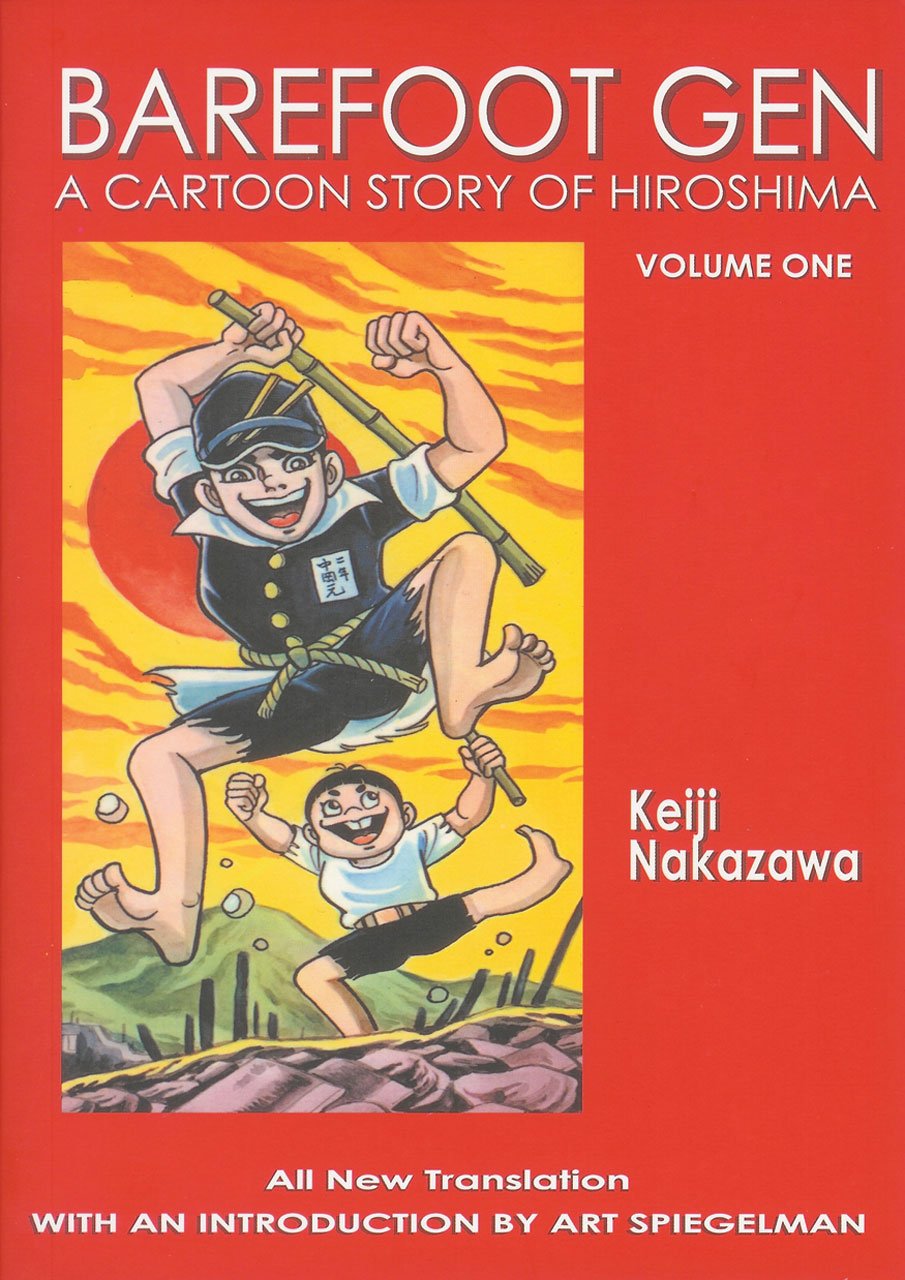
Nakazawa, Keiji. Barefoot
Gen. Trans. Project Gen. Vol. 1. San Francisco, CA: Last Gasp of San
Francisco, 2004. Print.
Multimedia Texts
“World War II:
Crash Course World History #38.” YouTube.
Uploaded by CrashCourse, 11 October 2012, <https://www.youtube.com/watch?v=Q78COTwT7nE&t=212s>
This video, presented by John Green via the Crash Course
World History series, is a very brief summary of World War II from a global
perspective, meaning it aims to cover both the European and Pacific
Theatres. Obviously, because it is only
ten minutes long, it does not have the opportunity to go into a great amount of
depth. What it does do, however, is
illustrate just how complicated this war was and what a global affect it had
and that is why I love it for the purpose of this assignment.
This text is fairly straight forward in nature, as it is
largely informational and aims to present information in the simplest way
possible. However, the events being
presented are what add complexity.
- Text Structure: Moderately complex. The events are presented and explained chronologically. However, because so many events overlapped and were both connected and disjointed in a lot of ways.
- Language Features: Slightly complex. The language itself is straightforward and literal and vocabulary is simple. This is the entire point of the Crash Course channel, to present topics that may be intimidating in the most digestible way possible while also being true to the subject matter (can you tell I’m a fan?).
- Meaning: Moderately complex. There are two meanings, presenting the events and presenting the way that these events are perceived. These two meanings are clearly distinguished from one another.
- Knowledge Demands: Moderately complex. Explicitly explores history as human and complex, not just the dates. A willingness to let history be this is needed and a basic knowledge of how World War II happened, even if it is not detailed.
Task complexity: the purpose of
this video is meant to be introductory.
I’m assuming some knowledge of both theaters from history classes,
regardless of how the history teacher chooses to present it, but this is my way
of ensuring students share the same base of knowledge and activate previous
knowledge. I would also like this to
open up room for questions and discussions for students who feel hesitant about
their level of knowledge.
This text would function to shed a little more light on the Pacific theater, as this is the side of the war many students are less familiar with
Hoffman, Bernard. "Hiroshima." Time
2016. Web.
Culturally Relevant Texts
Taylor, Allan.
"London During the Blitz: Then and Now Photos." The Atlantic. 9
May 2016. Web. <https://www.theatlantic.com/photo/2016/05/london-during-the-blitz-then-and-now-photographs/481851/>

I may be reaching for cultural
relevance because I like this article and project so much, but hear me
out! This article shows a series of
digital composition images which overlay images of modern day London with
images from the Blitz in the same location.
The hope is that the connection to the modern city of London helps
connect these events to the larger picture of the modern world. That this wasn’t just something that happened
in London, but something that happened in Germany and Japan. That these aren’t just dates on a page, but
real people who had real lives. That
this city could have been their city (an idea that is meant to work in tandem
with the piece on the effect of the war in Milwaukee). The images I would
want to focus on especially for this are the ones containing modern people
walking on the scene and the one containing a Burger King.
Running the text through
StoryToolz, the text of the article received a medium quantitative rating of
grade 14.7. I don’t disagree with this, and
this is far and above the quantitative measures given to every other text I’m
using. The reason I choose to disregard
this is that I am not interested in the written text, but just the images. I think that, especially with teacher
guidance, these images would still be useful to my ends.
Vocabulary
·
Blitz/Blitzkrieg – intensive or sudden military
attack. The London Blitz refers to the
WWII period from 1940-1941 in which London was regularly air raided by the
Germans.
Because this is my goal of using
the text, I am going to continue into the qualitative portion of my analysis as
such.
·
Text Structure: Moderately complex. Organization and juxtaposition of the images
is more implicit in some images than others (I find the images containing
better known landmarks to be more explicit then the lesser known).
·
Purpose: Slightly/Moderately complex. While the purpose of the text is clearly
stated, this is in the portion of the text that was also given a higher reading
level than what we are intended to work with here.
·
Knowledge Demands: Moderately complex. The discipline specific knowledge required is
discipline specific, but basic enough that it is covered in the brief
historical introduction. Otherwise, a
general knowledge of what London looks like is enough to make the image
connections, and a large number of people have gained this through popular
culture.
The purpose of this task is to motivate interest by making
connections between historical events, literary texts, and modern life. I would have the intention of viewing these
images as a quick activity following the article to be discussed as a
class.
Jones, Meg. "World War II pilot's family finds his plane's nose art." Milwaukee Journal Sentinal December 19, 2016. Web.
Jones, Meg. "World War II pilot's family finds his plane's nose art." Milwaukee Journal Sentinal December 19, 2016. Web.
Sunday, March 12, 2017
Disciplinary Literacy!
Disciplinary literacy, and how it
can be applied with adolescence, is especially interesting to me as someone who
has studied multiple disciplines. It is
relevant to how we teach within our own discipline, what our expectations are
of our fellow educators, and how we work on cross disciplinary projects (such
as my own). For now, however, I want to
focus on what disciplinary literacy is and why implementing it at the secondary
school level could be valuable.
Disciplinary literacy, as applied
in the school setting, is the belief and application that literacy is anchored
in the discipline in which it is practiced.
This means that there should be a focus on developing more specialized
literacy skills. This is opposed to the
idea of content area literacy (which is quite common at the secondary school
level), which assumes that reading and writing is generally the same across the
content areas and therefore doesn’t need to be taught in any sort of
specialized ways (Fang, 628).
As a preservice English Language
Arts teacher, both approaches have very practical effects on how I teach and
how I interact with my colleagues. It is
a common perception that ELA teachers are primarily responsible for all reading
and writing instruction and that all “writing is writing is writing” and all
“reading is reading is reading” (Smagorinsky, 141). What this means is that teachers who believe
this also believe that they also believe that building these skills belongs in
the ELA classroom and only the ELA classroom.
However, Smagorinsky argues that this is not the case. There are basic characteristics that carry
over, such as building cohesive sentences and paragraphs, but this is not
everything. What writers need to be
truly affective is what is called “communicative competence,” and this is what
varies across the disciplines. Communicative
competence is defined as the ability to adjust ones speech and writing to fit
the situation, and different disciplines require language to be used
differently (Smagorinsky, 143). Meaning,
the way you express yourself and seek information in an English classroom is
different than the way you would do so in a science, math, or history
classroom. As a former English and
History student, my response to this was “well, of course!” However, the question from here becomes
whether or not it is affective to introduce these strategies at the novice
level (secondary school) or if it should wait until they are seeking expertise
in a field (higher education).
The different literacy needs of the
disciplines is a phenomenon on which sociocultural scholars agree as well, that
literacy is incredibly complex and we use different tools based on the need of
the situation. This all being said, if disciplinary
literacy is to be introduced at the middle or high school level it does require
careful scaffolding on the part of the teacher.
Middle and high school students are not specialized scholars in these
areas, so creating opportunities for them to hone skills and better learn what
these literacies look like is crucial to greater understanding (Rainey, 54-55). This is what can make enacting this model
challenging. It is difficult to
introduce new practices, especially in secondary schools, because students have
begun to develop expectations and beliefs about what literacy looks like,
especially if they feel that subject area literacy is working for them. For this reason, as well as many teachers own
skepticism, many teachers forego enacting it at all and favor sticking to the
status quo (Moje, 98). The changes that would need to take place in
order for disciplinary literacy to function most effectively involves a change
in the structure of the school, not just a single classroom; this includes
students, teachers, and administrators. This
allows teachers to better support students, if administrators are supporting
them in this dynamic (Moje, 105). This
is where teachers expectations of one another come in, and this can already be
a muddled area without introducing new literacy practices. Returning to Smagorinsky, there is already a discrepancy
between teachers as to just who is responsible for literacy of students. An added flexibility between the disciplines
on this issue, as well as greater support between teachers, would also allow
for more collaboration. In a cross
disciplinary project there are more opportunities for collaboration between
teachers and for them to show the literacies of the disciplines juxtaposed to
one another.
Lastly, I want to return to what disciplinary
literacy looks like in the ELA classroom.
This would be the most pertinent to my own interests. ELA is often seen is the only place in which
literacy education takes place. Literary
literacy, for instance, involves a series of skills that are most commonly used. These include finding and seeking patterns
within texts and between texts; identifying strangeness, surprise, and
confusion; considering the history behind the text and other contexts; and making
original observations about the text (Rainey, 62-65). There are a variety of ways teachers can go
about introducing these, but they are all incredibly relevant to teaching
literary texts.
This is also only scratching the
surface of the requirements of literary literacy and the argument for
disciplinary literacy, of course, and look forward to continuing to learn about
it and implement what I learn.
Friday, February 10, 2017
Literature, History, and the Connections We Make
As someone with an avid interest in
literature and history, I’m partial to texts that merge these interests. This is where I intend to focus on and
explore. As this is obviously quite
broad, I’ll be focusing on World War II in literature. This ranges from historical fiction to
memoirs and autobiographical work to graphic novels.

Going in, World War II is an area
that I consider myself to be knowledgeable in, both from academic and personal
study. Thinking of this as if it were a
unit I were to cover in a classroom, this background knowledge is great for providing lessons on
contextualization. I’ve focused my own
study largely on the European theater, but still know a fair amount about the
Pacific theater. As a result, I feel
inclined to focus on the European theater and place the Pacific in the greater
context of this project.
There’s also a significant amount
of literature on this topic, I’ve found it geared both towards adults and young
adults. I’m inclined to focus on young
adult literature. A number of texts come to mind, even when narrowing the topic down to YA. For example: The Book Thief, Number the Stars, Maus, and Barefoot Gen. A number of texts, such as The Diary of Anne Frank (image and link above) and Elie Wiesels Night, are already found in many English classrooms.

So I’ve stroked my ego enough by
talking about what I know about World War II and the texts I’ve read. What can I stand to learn by continuing to
focus my attention on this area? I’m
interested in placing historical fiction in conjunction with autobiographical texts,
and focusing on the different reading strategies used for these texts in the
classroom. I'm also interested in learning more ways that these texts can inform the ways that we look at current events.
Thursday, February 2, 2017
Hello and welcome to my blog!
I am a graduate student here at UWM and I'm working towards my Masters and certification in English education. I did my undergraduate work at the University of Iowa, where I double majored in English and History. I found these two subjects worked extremely well together and often helped flesh one another out as I worked. For instance, literature often provides a cultural insight to a period in history, or history can present context to the world of events taking place in literature. Hopefully this knowledge also helps me with future classes too.
The experience of history helping me engage further with literature (because I'm a huge nerd) also makes me wonder about ways that I could help my future students engage with texts that they otherwise would not read. Mostly, I'm interested in creating connections. The connections that have impacted me most are history and seeing places I've read about. The next step is helping students learn to make connections in their own ways.

Example: seeing the light post rumored to be C.S. Lewis inspiration for the entrance to Narnia.
I am a graduate student here at UWM and I'm working towards my Masters and certification in English education. I did my undergraduate work at the University of Iowa, where I double majored in English and History. I found these two subjects worked extremely well together and often helped flesh one another out as I worked. For instance, literature often provides a cultural insight to a period in history, or history can present context to the world of events taking place in literature. Hopefully this knowledge also helps me with future classes too.
The experience of history helping me engage further with literature (because I'm a huge nerd) also makes me wonder about ways that I could help my future students engage with texts that they otherwise would not read. Mostly, I'm interested in creating connections. The connections that have impacted me most are history and seeing places I've read about. The next step is helping students learn to make connections in their own ways.

Example: seeing the light post rumored to be C.S. Lewis inspiration for the entrance to Narnia.
Subscribe to:
Posts (Atom)